
STAYING INFORMED
Catch up with the latest trends and developments in sustainable fashion.
“Fast fashion is not free. Someone, somewhere is paying the price.” – Lucy Siegle, British journalist and writer

Sustainable Fashion brands:

01
PATAGONIA
Patagonia was established with a mission to support outdoor adventures and has long been a trailblazer in environmental conservation. Since 1985, the company has pledged 1% of its sales towards preserving and restoring the natural environment. Founder Yvon Chouinard encourages other businesses to follow this model.
Manufacturing materials contribute around 85% of its yearly emissions so for nearly three decades, Patagonia has sought ways to minimise this impact. In 1996, it began using only organically grown cotton for products containing virgin cotton. The company aims to eliminate all virgin petroleum-based materials from its products.
In 2022, Yvon transferred Patagonia’s ownership to a trust and a non-profit organisation to ensure the company’s profits are used solely to combat climate change. "While we’re doing our best to address the environmental crisis, it’s not enough,” he said when announcing the decision.
02
NIKE
All of the waste in Nike’s extended supply chain is diverted from landfill, and at least 80% of this is recycled back into Nike products and other goods. Further contributing to circularity, it also offers recycling and donation services and sources a mix of eligible returns and open box footwear for refurbished sales.
Nike collects local vintage and deadstock products and uses the materials to create newly designed and manufactured pieces.


03
LULULEMON
Lululemon’s Impact Agenda is integrated into its overall strategy and operations as the company believes individual, community and planetary wellbeing are all linked.
“As we continue our Impact journey, partnership and collaboration remain important components of our approach to navigating and helping to solve the complex environmental and social challenges we face,” says Esther Speck, Senior Vice President, Sustainable Business & Impact.
When zips, seams or other parts of a Lululemon garment break, the company says it will fix them “on the house”.
04
LEVI'S
“There’s no denying that the fashion industry plays a part in today’s climate crisis,” Levi’s says.
The brand is taking steps across its business to adopt new practices that have less negative impact on the planet. Its Climate Transition Plan details its path for the future including achieving a 42% absolute reduction in supply chain emissions by 2030.
Jeffrey Hogue, Chief Sustainability Officer at Levi Strauss & Co., explains: “We’re scaling up what works, innovating where it’s needed and collaborating with the industry to do our part.”
To read the full article in the magazine, click HERE.


Brands to approach with CAUTION

"People are purchasing more clothing than ever before, yet wearing it far less frequently. This trend can largely be attributed to the rapid rise of fast fashion over the last twenty years."
We want to clarify that this platform is aimed at consumers who acquire more clothing than necessary. Our intention is not to criticize low-income shoppers who may rely on fast fashion due to affordability. However, the existence of these fast fashion brands is a result of overconsumption. It’s about our buying habits as consumers; many of us possess an excess of clothing.
HOW TO RECOGNIZE FAST FASHION BRANDS:
Most fast fashion brands launch new clothing collections weekly and employ marketing strategies to entice consumers into following new trends.
These companies often lack transparency, providing limited information about their suppliers and manufacturing processes. They fail to specify what measures they are taking to reduce their environmental impact and do not demonstrate that they ensure safe working conditions and fair wages for their workers.
Many fast fashion brands engage in greenwashing, offering misleading information to create the illusion of being ethical and sustainable.
Additionally, low prices are a strong indicator of fast fashion products and their poor quality. It is unrealistic to produce a $5 t-shirt while fairly compensating garment workers and maintaining environmentally friendly manufacturing practices.

01
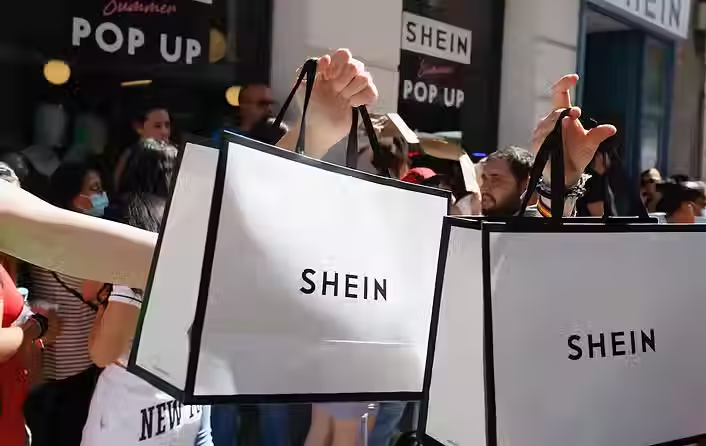
SHEIN
In 2023, Shein became a leading force in fast fashion, using advanced AI technologies to rapidly produce and distribute cheap clothing worldwide. However, this model results in significant environmental harm, with the company emitting 16.7 million metric tons of carbon dioxide, largely due to its reliance on air shipping and high levels of textile waste. Labor practices are also troubling, as reports reveal workers often endure exploitative conditions, including 75-hour workweeks. Despite claims of sustainability, Shein is accused of greenwashing, with emissions rising sharply even as it pledges to reduce its carbon footprint. Shein prioritizes profit over ethical considerations, exacerbating the fashion industry's sustainability crisis.
Learn more HERE
03
H&M
H&M faces significant scrutiny for its environmental impact and labor practices as a major player in the fast fashion industry. While the brand promotes a sustainable image, producing 3 billion garments in 2019 and claiming that 84% of its materials are sourced sustainably, studies have shown that much of this is misleading. Only 23% of its materials are actually recycled, and the recycling processes are energy-intensive and difficult to trace. H&M's marketing often obscures the reality of its practices, contributing to greenwashing concerns. Additionally, the company has been criticized for poor labor conditions, with many workers earning below the international poverty line and facing unsafe working environments. Despite some progress in sustainability initiatives, H&M's fundamentally unsustainable fast fashion model prioritizes profit over ethical practices, making genuine transformation essential for a more responsible future in fashion.
Learn more HERE
02
ZARA
Zara, a leading fast fashion brand, exemplifies the challenges of sustainability in the fashion industry. Over the past 30 years, Zara has contributed to misguided consumer expectations for low-priced apparel, overshadowing ethical brands that prioritize responsible production. The brand’s rapid production cycles and reliance on cheap, environmentally harmful materials, such as polyester, exacerbate its negative environmental impact, including significant greenhouse gas emissions and textile waste. Moreover, the social implications are severe, as the pursuit of low costs often leads to the exploitation of garment workers in unsafe conditions. Despite claims of sustainability, Zara's business model fosters a throwaway culture, making genuine ethical practices nearly impossible. True sustainability for Zara would require a fundamental shift away from its current practices, which prioritize speed and profit over ethical considerations.
Learn more HERE
04
TEMU
Temu, a fast-growing marketplace launched by PDD Holdings, has rapidly expanded since its U.S. debut in 2022, attracting consumers with its vast range of extremely low-priced products. However, the brand's lack of transparency raises significant red flags regarding its ethical practices. Temu's business model promotes overconsumption and is linked to environmental harm, with an estimated 600,000 packages shipped daily to the U.S. The company claims an ongoing commitment to sustainability but relies on questionable initiatives, like a tree-planting program that appears more like greenwashing. Labor conditions are also concerning; while Temu states it prohibits forced labor, it does not provide details on enforcement or supplier practices. A congressional inquiry into the brand's compliance with U.S. anti-forced labor laws highlights the potential for human rights abuses. Temu's lack of accountability and transparency, combined with its promotion of unsustainable consumption, earns it the lowest rating from ethical standards.
Learn more HERE
